
Dakar Future Mission 1000: the laboratory of innovation


The Dakar Rally, long heralded as the world’s toughest off-road motorsport, has always pushed machines and crews to extreme limits. Now, with sustainability and future propulsion technologies becoming central to global automotive progress, the rally has introduced an innovative challenge that looks beyond outright speed: Mission 1000.

What Is Mission 1000?
Mission 1000 is a special category within the Dakar Future programme, an initiative launched in 2021 to nurture and test alternative energy propulsion systems under the harshest terrain imaginable: the Saudi desert. Unlike traditional race categories, Mission 1000 is not designed purely for competition but instead acts as a real-world testing ground for technologies like electric powertrains, hydrogen fuel systems, hybrid configurations, and advanced biofuel applications.

Vehicles in Mission 1000 are evaluated over a sequence of daily challenges on routes of approximately 100 km, collectively covering around 1000 km of selective sectors that mirror the main Dakar Rally’s demands. The focus is on reliability, autonomy, efficiency and performance under extreme conditions rather than outright race wins.

Mission 1000 in Dakar 2026
For the 2026 edition of the Dakar Rally (3–17 January in Saudi Arabia), Mission 1000 continues its evolution into a pivotal arena for alternative propulsion tech. The 2026 line-up highlights a diverse set of experimental machines that reflect the future of off-road powered mobility.
Electric Motorcycles Take Center Stage
One of the most notable trends in Mission 1000 2026 is the emphasis on 100 % electric motorcycles, a breakthrough for two-wheeled endurance technology:

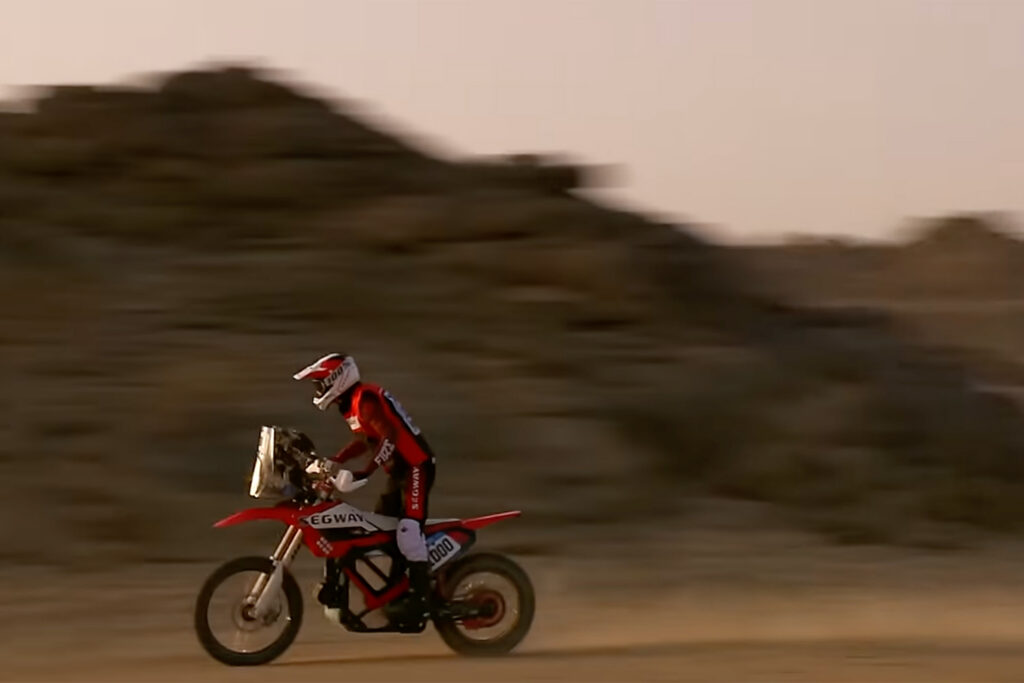
- Segway: The Chinese-based mobility giant has returned to the challenge with three electric rally bikes (often referenced as the Segway Dakar Race Bike or Segway X1000 prototype). These bikes feature more efficient batteries and substantial weight reduction versus previous versions, improving both range and handling. Segway is using the Dakar 2026 event as an experimental ground to test and develop their electric off-road motorcycle technology.
- Arctic Leopard: This private Spanish Arctic Leopard Galicia Team has entered three Arctic Leopard E.XE-880 electric motorcycles, optimized from prior Dakar participations. These bikes aim to push the boundaries of off-road electric performance.

Across Mission 1000, six electric motorbikes are competing daily across sectors of around 100 km, testing real-world battery performance, thermal management, and rider endurance in hot desert conditions.
Why Mission 1000 Matters
Mission 1000 is more than a side-event: it is a crucible for the future of off-road mobility and sustainable propulsion.
- Real-world data: Engineers and designers test their technologies in conditions that no lab can replicate, extreme heat, sand, rocks, and daily stresses that reveal weaknesses and strengths alike.
- Progressive evolution: Results from the 2024 and 2025 editions already show valuable learnings for durability, battery thermal management, and hydrogen integration, guiding future development cycles.
- Beyond racing: While typical Dakar categories chase podium glory, Mission 1000’s philosophy is about transformative innovation. Manufacturers take risks, and sometimes fail, but every challenge expands understanding of what’s possible.
Hybrid and Hydrogen Systems
While two-wheeled electric power is grabbing headlines, hybrid and hydrogen propulsion remain core areas of experimentation:
- KH7 Ecovergy Hybrid Truck: A veteran of the Mission 1000 challenge, this Spanish team runs a hydrogen & biodiesel hybrid truck that has historically performed well in previous editions, combining novel fuel strategies with rugged truck design.
- Hydrogen Fuel Projects: Previous Dakar campaigns have seen collaborations like the HySE (Hydrogen Small mobility & Engine technology Association) project, a coalition of manufacturers developing hydrogen-powered SSVs, underscoring the commitment to non-fossil fuel alternatives in off-road environments.
Conclusion
The Dakar Future Mission 1000 challenge stands at the frontier of motorsport and sustainable technology. It demonstrates how extreme competition settings can accelerate the transition to cleaner, more efficient propulsion systems, from electric two-wheelers to hydrogen-hybrid trucks. Whether for manufacturers seeking data or engineers hungry for real-world validation, Mission 1000 is the ultimate proving ground for the technologies that may one day power mainstream transport across the globe.
More info about the Dakar Rally: