
Electric motorcycles are entering the military arena

 Electric motorcycles
 ACS EMU, Gr1T Motorcycles, NorthForge Dispatch, STRiX eMotors, Sur Ron, USC WolfStorm, Zero Motorcycles
The electric motorcycle’s advantages in stealth and low maintenance have been recognized by public service fleets for years. But a growing number of manufacturers are now engineering two-wheelers specifically for military applications. Silent running, near-zero thermal signature, swappable batteries, and the ability to operate in extreme terrain are no longer just nice-to-haves, they are the design brief. Five machines currently illustrate where this category is heading.
STRiX Hard Enduro
The Slovenian company STRiX eMotors was founded in 2023 in Maribor with a single goal: build an electric hard-enduro motorcycle to military standards. It presented the prototype at EICMA 2024, and the production machine entered deliveries in 2025.

The numbers are serious. The STRiX Hard Enduro puts out 70 kW and 1,050 Nm of torque at the rear wheel. It weighs 138 kg and reaches a top speed of 130 km/h. The 6.3 kWh NMC battery supports DC fast charging at up to 18 kW via CCS, taking the pack from 20 to 80 percent in around ten minutes. It can also be swapped in under a minute. The chrome-molybdenum frame houses Showa suspension up front and an Ohlins unit at the rear. All components are waterproof, and the bike includes a reverse gear, useful in tight operational situations where a combustion engine would require a far more complicated maneuver.

In stealth mode, the STRiX is silent within 20 meters and produces a significantly reduced infrared signature compared to an internal combustion engine. The platform supports up to 150 kg of cargo including weapons, gear, and extra batteries, with dedicated mounting points throughout the frame. STRiX has been evaluated by the Belgian Army, tested by NATO troops and the US Navy, and demonstrated to the defence ministries of Slovenia and Estonia. THE PACK was present at the Belgian Army evaluation.
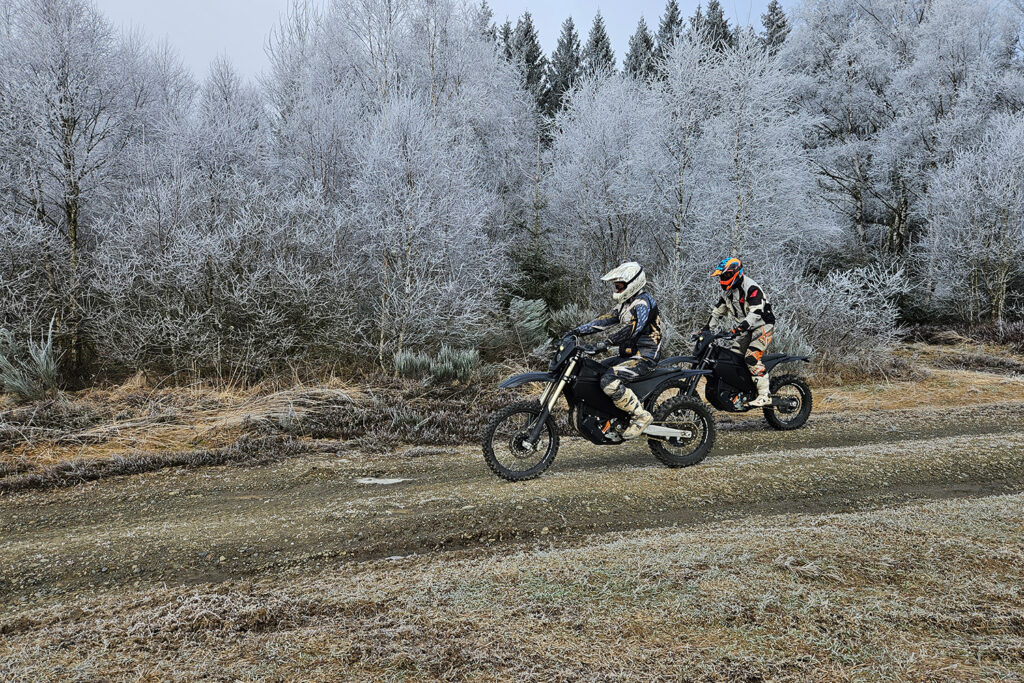
STRiX has also announced a Dakar Rally programme in collaboration with Portuguese rider Pedro Bianchi Prata, targeting the Mission 1000 category from 2027. The road to Dakar serves as both a development programme and a visibility play for a company that built its reputation in defence before moving into the civilian and competition markets.
USC WolfStorm
Born directly from the conflict on Ukrainian soil, the WolfStorm is a product of genuine battlefield demand. Developed by Ukrainian company UkrSpecConsulting, the bike was tested with Special Operations Forces of the Armed Forces of Ukraine and, in May 2026, was officially codified and approved for military service by Ukraine’s Ministry of Defence. In 2026, the Defence Procurement Agency signed contracts for 1,500 units, three times the procurement volume of the previous year.

The WolfStorm is built around an 8 kW mid-drive brushless DC motor, centrally mounted for optimal weight distribution on rough terrain. It weighs 105 kg and carries a payload of 200 kg, enough for two soldiers in full combat gear. Top speed is at least 80 km/h, and range is rated at 100 km from a 72V, 60Ah lithium-ion battery. A full charge takes approximately four hours, but the battery can be swapped in the field as an alternative to waiting. The electrical system carries an IP66 protection rating, meaning it operates in dust, dirt, rain, and high humidity without issue. Ground clearance stands at 380 mm.

Ukraine’s Ministry of Defence specifically cited silence, the absence of a thermal footprint, and the ability to transport two soldiers as the key reasons for adoption. The WolfStorm has been cleared for reconnaissance, EOD transport, UAV crew deployment, logistics, casualty evacuation, and facility patrol duties. The chain drive – louder than a belt, but simpler to repair with common tools in the field – reflects a deliberate design priority: sustainability in combat conditions, not refinement.
Our German mediapartner published recently an article about WolfStorm:
NorthForge Dispatch
Canada’s entry into this space comes from NorthForge Mobility, based in Alberta. The Dispatch is a sovereign Canadian platform, with the company citing 80 percent Canadian content and a design philosophy explicitly aligned with NATO and allied procurement standards.

The specification sheet covers the full range of operational challenges: temperature performance from minus 45 to plus 45 degrees Celsius, a claimed range of up to 200 km, and a payload capacity of 200 kg. Noise output is capped at a maximum of 50 decibels. The thermal signature is cited as only five degrees above ambient: a direct response to the growing prevalence of thermal optics and drone-based surveillance on the modern battlefield. The battery system is divided into independent modules, allowing the Dispatch to keep running even if one section is disabled. Battery swaps take under one minute. The platform packs down to a five-by-three-by-two-foot logistical footprint and can be reconfigured for multiple mission profiles using integrated hard points. Maintenance has been designed to require only common tools and minimal technical knowledge, reducing the demand on field logistics.

Intended roles include dispatch rider operations, UAV deployment, ISR support, casualty extraction via a medical trailer hitch, remote power generation, and Arctic mobility. NorthForge is currently inviting defence procurement enquiries and partnership discussions through its website.
GR1T Motorcycles Raider
Italy’s GR1T Motorcycles takes a different approach to the military segment: rather than building a dedicated defence vehicle, the Berlin-based startup has extended its existing G1 platform into a dual-use configuration called the Raider, unveiled at the Motor Bike Expo in Verona in early 2026.
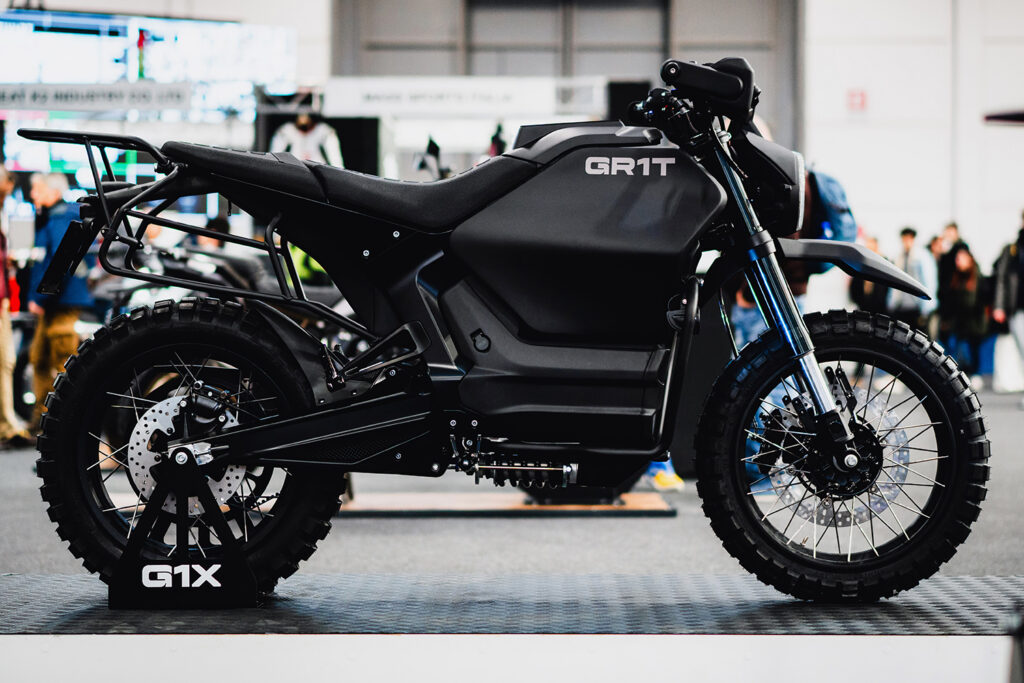
The Raider builds on the same architecture as the G1S street motorcycle and G1X scrambler, adding infrared shielding on the motor, inverters, and batteries to reduce thermal detectability under sustained load. Electric motorcycles inherently avoid the exhaust heat signature of combustion engines, but powertrain components still generate detectable thermal output during extended operation. GR1T addresses this directly as a design constraint. The Raider also features heavy-duty waterproofing, increased ground clearance, off-road tyres, an extended and reinforced rear section with multiple hard mounting points for equipment, and additional attachment options throughout the frame.
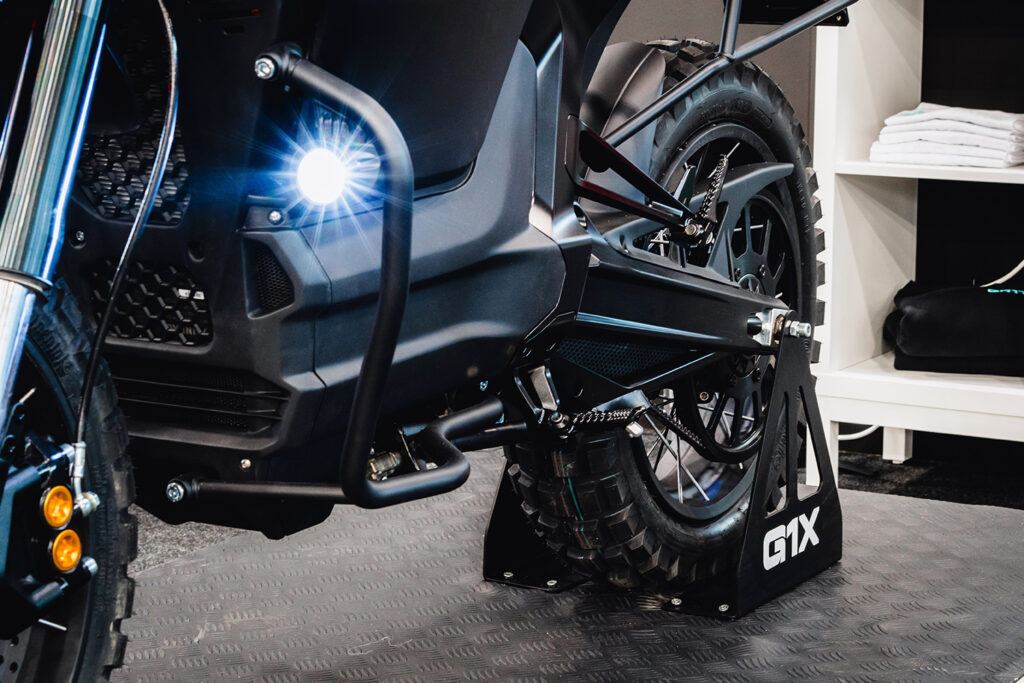
Performance figures draw from the proven G1 platform: peak output of 27.8 kW, top speed of 130 km/h, and a range of up to 150 km depending on configuration and usage. Two removable batteries are standard. GR1T has been transparent that the Raider is a concept statement at this stage – a demonstration of how far the G1 architecture can stretch – rather than a finished product ready for procurement. That honesty is worth noting. The G1S and G1X are the products moving toward production; the Raider signals intent and tests whether the platform architecture holds up under a much harder design brief.
ACS EMU
The EMU comes from a different direction than the other machines on this list. ACS Armoured Car Systems is a German company based in Friedberg, part of the family-owned GRUMA Group, with decades of experience building custom operational vehicles for military and security clients. Their product range includes the ENOK family of armoured carriers, supplied to armed forces across Europe. The EMU is their electric motorcycle entry, built on the platform of French manufacturer Electric Motion, a company with a strong track record in high-performance off-road electric bikes.

What ACS brings to that foundation is systems integration and military context. The EMU has been developed iteratively using direct feedback from soldiers, resulting in a machine whose specification reflects actual operational requirements rather than assumed ones. It weighs 80 kg, reaches a top speed of 77 km/h, and offers a range of 60 km with a swappable battery that charges fully in around two hours and fifteen minutes at 25A. Power output spans 6 to 11 kW depending on mode, with 600 Nm of torque at the rear wheel. Three engine maps – off-road, wet, and performance – cover the main tactical environments. The bike can be ridden on a 125cc licence, which reduces the training burden for military units.


The most distinctive aspect of the ACS proposition is the integration angle. The EMU is designed to be deployed either independently or in direct combination with the ENOK AB, ACS’s operational vehicle. That pairing opens tactical options that neither platform provides alone: a small unit can arrive by vehicle and immediately deploy on foot or by bike depending on the situation, without requiring separate logistics for the motorcycle. For a company whose business is delivering complete system solutions to defence clients, the EMU is less a standalone product than an element in a broader capability package.
More players in the field
These five are not alone. The electric motorcycle industry has been developing military-grade or military-adjacent platforms for over a decade, and the field is broader than it might appear. Zero Motorcycles has the longest track record in this space, having developed the MMX specifically for US Special Operations Command in 2013: a purpose-built military machine with swappable batteries, infrared lighting integration, and full submersion capability. The MMX has since been evaluated and deployed by special operations units across several countries, and Zero FX models have been spotted mounted on Black Hawk helicopter stub wings by UAE special forces.

Video © DIAN Motors & Surron Canada
Beyond dedicated builds, a number of manufacturers produce platforms that lend themselves to military adaptation: Sur-Ron and other lightweight electric off-roaders have been used informally by Ukrainian forces throughout the conflict with Russia. The five machines profiled here is only a representation of purpose-built military electric motorcycles, but they sit within a much larger and still-developing ecosystem.
Editor’s note
Following the publication of this article, we were contacted by John Karambalis, founder of Australian company Stealth Electric Bikes. He pointed out, correctly, that Stealth has been supplying electric bikes to military and special operations forces since 2012, well before most of the manufacturers featured here had built their first prototype.
We should be transparent: Stealth’s products are electric bikes, not electric motorcycles in the strict sense, and it was the intention to focus on electric motorbikes. That distinction is why Stealth did not appear in our original lineup. However, given the company’s documented history with defence clients – including special forces units in Sweden, the US, Denmark, the Netherlands, France, Australia, Brunei, Jordan, Singapore, Canada, and NATO – we felt it would be wrong not to acknowledge them in this context.

Stealth Electric Bikes designs and supplies what it describes as non-traditional mobility solutions for personnel recovery, reconnaissance, and rapid deployment: all-terrain, low-profile platforms with minimal acoustic and thermal signature. The defense page on their website gives a glimpse of that activity: