
From EMGo Technology to Tornado Power Group: Odesa startup has a new name


From EMGo Technology to Tornado Power Group: the Odesa startup we’ve followed since 2020 has a new name, and a finished electric motorcycle.
Long-time readers of THE PACK will remember EMGo Technology, the Odesa-based engineering unit we first wrote about back in 2020, when it was working under GEON Motors on an ambitious project called the ScrAmper. Over the following years we followed the team through an open letter asking for international support after the invasion of Ukraine, a serial production announcement, and a 2023 search for investors to get the ScrAmper S1 off the ground.

Five years on, we’ve discovered the company operating under a new name and a considerably wider business. EMGo Technology is now Tornado Power Group, present online at tornado.energy. The company states it was founded in Odesa in 2014 and runs a 4,000 m² manufacturing facility in the city, with in-house mechanical and electrical workshops, battery assembly lines, prototyping, and a test lab. We could not find a public announcement explaining the name change itself, but the continuity with EMGo is unmistakable: the ScrAmper platform, the Odesa base, and even a leftover image file on the company’s own “About” page named “Scramper_emgo_technology_1.jpg” all tie the two identities together.
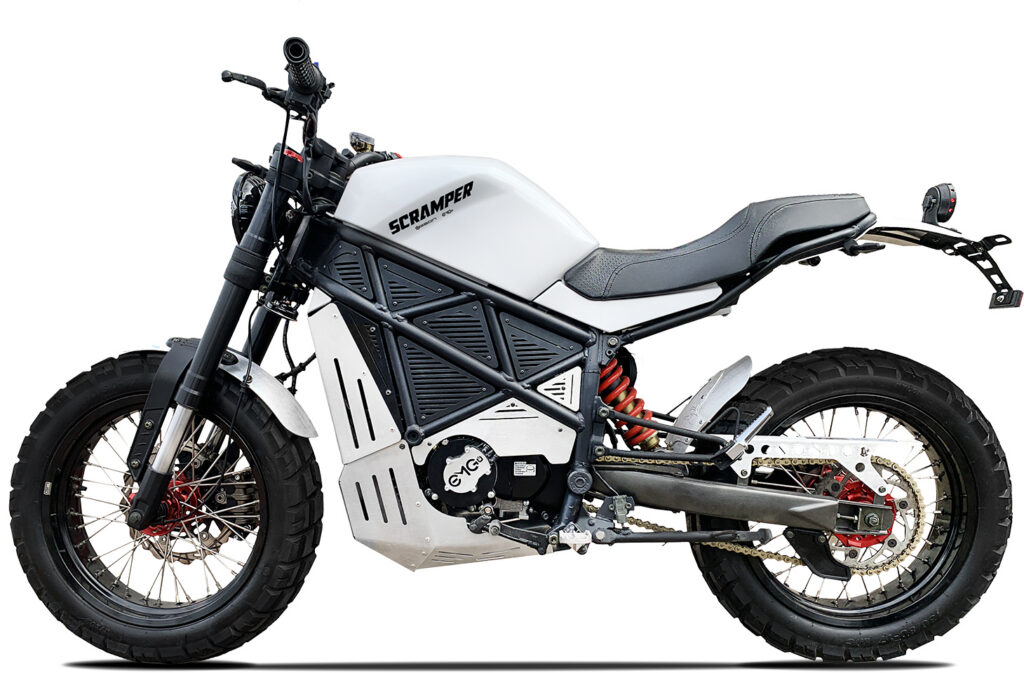
What has changed is the scope of the business. Where EMGo Technology positioned itself around e-mobility and home energy storage, Tornado Power now describes itself as an engineering company for “battery systems, power electronics and electric powertrains for unmanned platforms, energy storage and electric mobility.” Its product lines now lead with batteries for FPV drones, commercial UAVs, UGVs, robotics, marine and industrial applications – categories that track closely with Ukraine’s wartime manufacturing economy. The ScrAmper motorcycle survives, but it’s now framed on the site as the company’s “flagship product,” a showcase for its engineering rather than its main line of business.
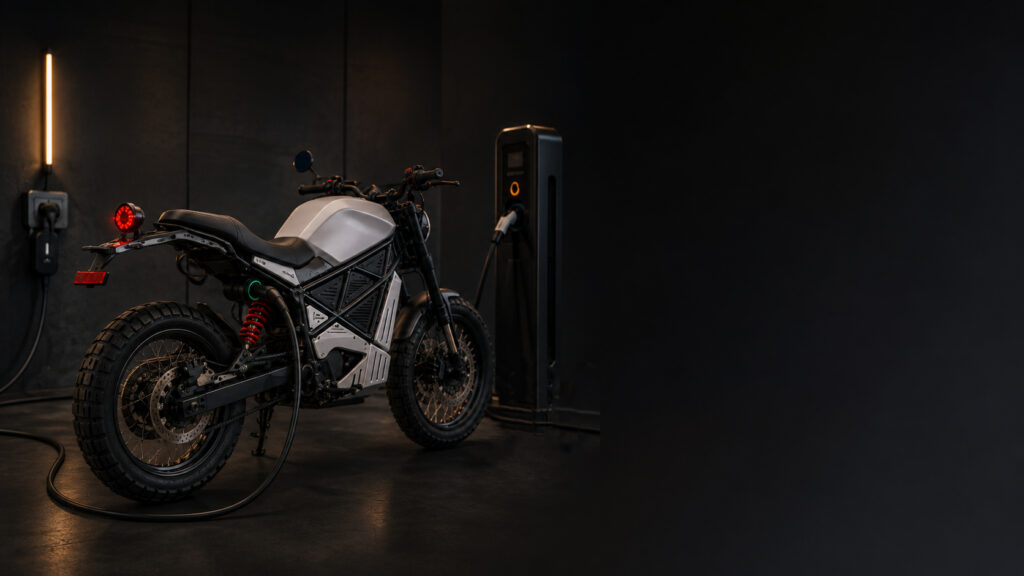
That flagship has matured considerably since we last covered it. The ScrAmper S1 is now a fully specified, priced production motorcycle rather than an investor pitch. It runs a 9 kWh Li-NCM battery for up to 200 km of range, with Eco, Normal and Sport ride modes. The central motor produces 11 kW nominal and 20 kW peak power, with 245 Nm of torque at the wheel and a top speed of 150 km/h. Charging is handled by a built-in 3.5 kW AC charger compatible with Type 2 connectors (Type 1 via adapter) on standard 110/220V power, taking the battery from 20 to 80 percent in 90 minutes, or a full charge in two and a half hours.
The most distinctive engineering choice is what Tornado Power calls PulseShift: a genuine 4-speed mechanical gearbox with a clutch, sitting between the electric motor and the rear wheel. It’s a deliberate attempt to keep the shifting feel of a combustion motorcycle rather than the single-speed, twist-and-go character of most electric bikes. Suspension is handled by an inverted front fork and a rear monoshock on a steel swingarm, with a 270mm front disc and 220mm rear disc on combined brakes. The bike sits on a 1380mm wheelbase with 17-inch wheels front and rear, and Tornado Power backs it with a 5-year frame warranty and a 2-year battery warranty. Starting price is set at €10,000.
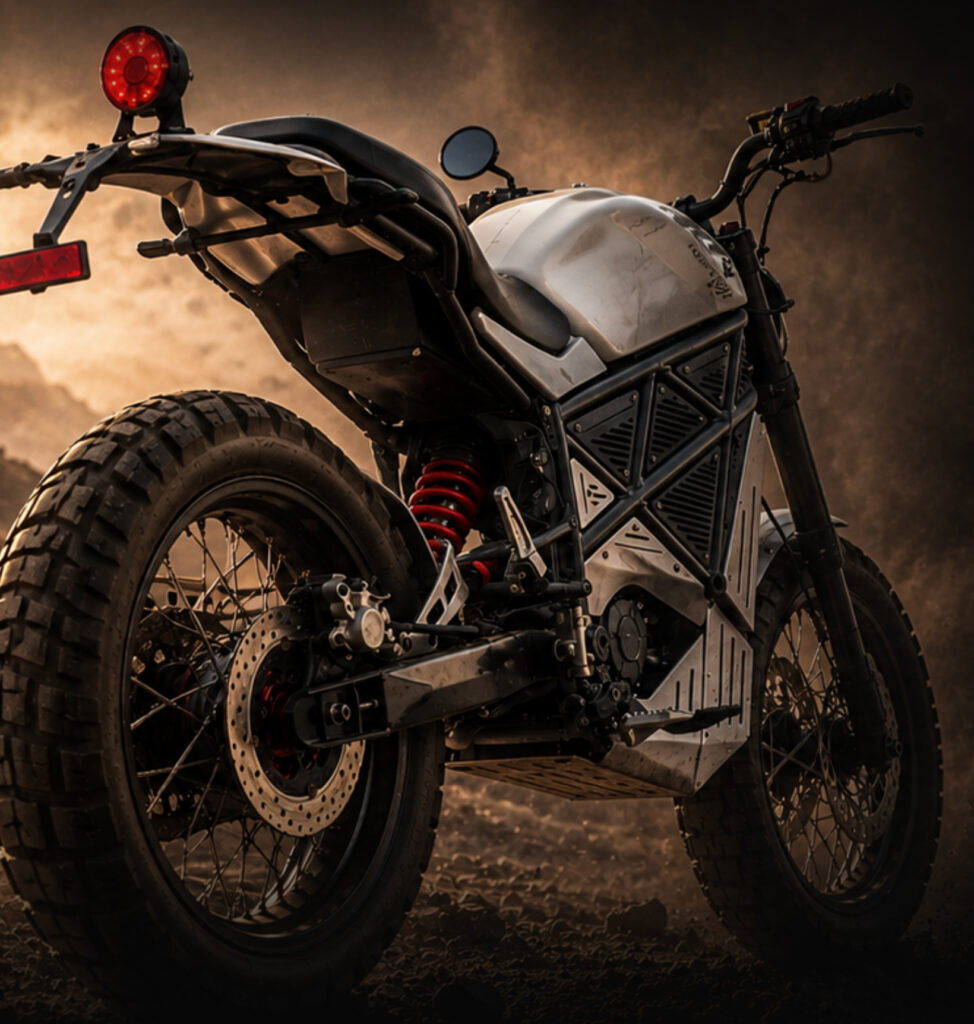
According to the company, the ScrAmper platform’s roots go back to 2019, when engineering teams from Odesa and Kyiv set out to build an electric motorcycle equally capable on road, in the city, and on light off-road terrain. Tornado Power describes the current version as the result of “several battery generations, a new frame, active cooling and multiple revisions of the power electronics and transmission” rather than a single design breakthrough – consistent with the long, difficult gestation we’ve tracked across our own coverage since 2020.
The bigger story here may not be the motorcycle at all. A civilian e-mobility startup that spent its early years asking the world to notice a scrambler-style electric bike from a country under invasion has repositioned itself as a battery and power-electronics engineering house serving unmanned platforms and defense-adjacent markets, alongside its original consumer product. The ScrAmper S1 is now less the company’s reason for being and more its proof of capability – a finished, priced, road-legal demonstration of engineering that Tornado Power is otherwise applying to drones, robotics and industrial energy storage out of wartime Odesa.