
The NERVA EXE II makes its Benelux debut

 Electric motorcycles, Test rides
 Electric Motorbikes Nederland, NERVA, Nerva Mobility, scooter&bikexpress
Source: thanks to Electric Motorbikes Netherlands, the official Benelux distributor for Nerva, and to scooter&bikexpress for the test and review. Author: Maurice van Oosten | Images: © Raymon de Kruijff

Nerva Mobility has long been a known quantity in Spain, where the brand was founded, but is now spreading its wings across Europe. The Benelux is the next market where Nerva wants to establish a foothold, and the brand is bringing its latest model to do the job: the EXE II, an electric maxi-scooter aimed squarely at the commuter segment, and positioned to take on both the Japanese and Italian petrol incumbents, and maybe even the car.
The electric two-wheeler market in the Benelux remains slow. Despite the presence of established names like BMW, LiveWire, Segway and Zero Motorcycles, the numbers tell a sobering story: last year BMW registered 47 electric scooters, Segway 38, LiveWire 16 and Zero 71, out of a total market of 19,614 units. Negligible figures. And yet the case for electric commuting has never been stronger. Anyone riding daily to work on an electric scooter is already seeing their monthly costs fall sharply, and rising fuel prices are only accelerating that calculation.
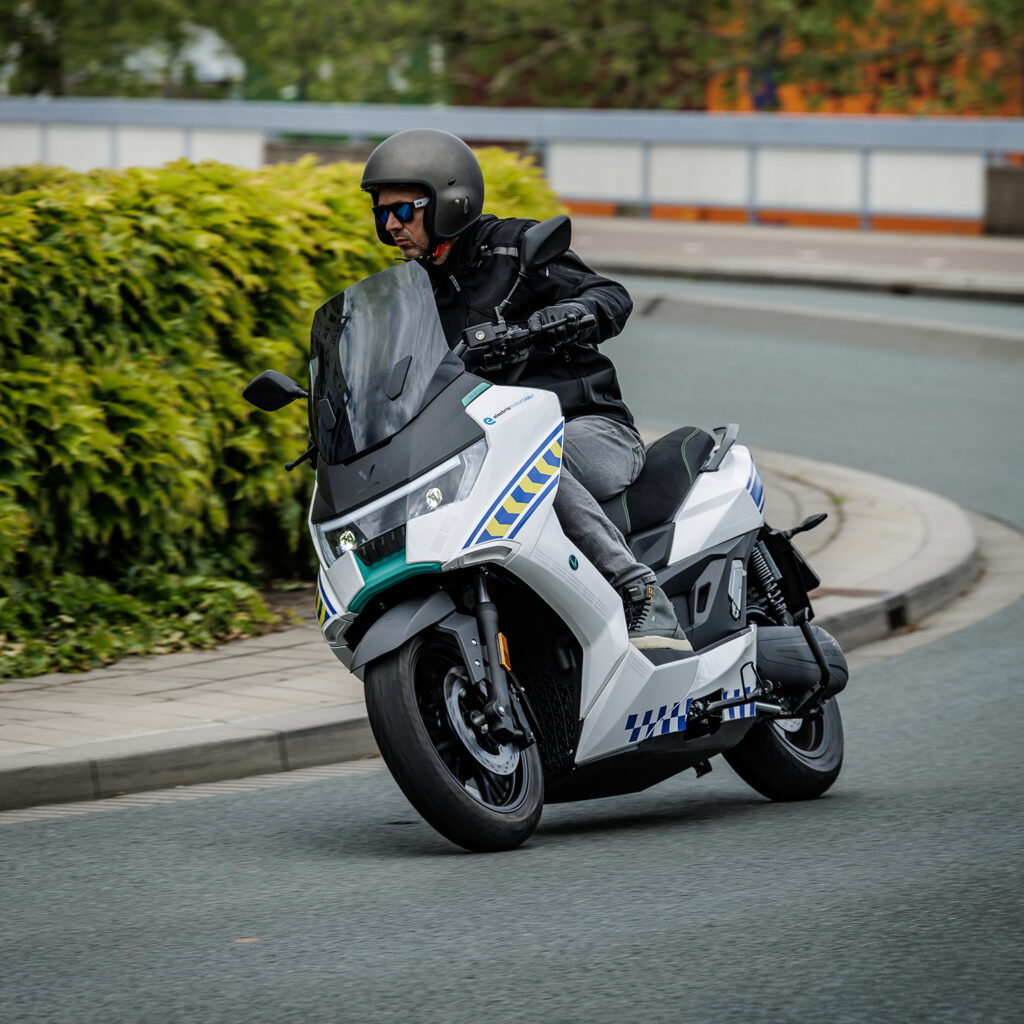
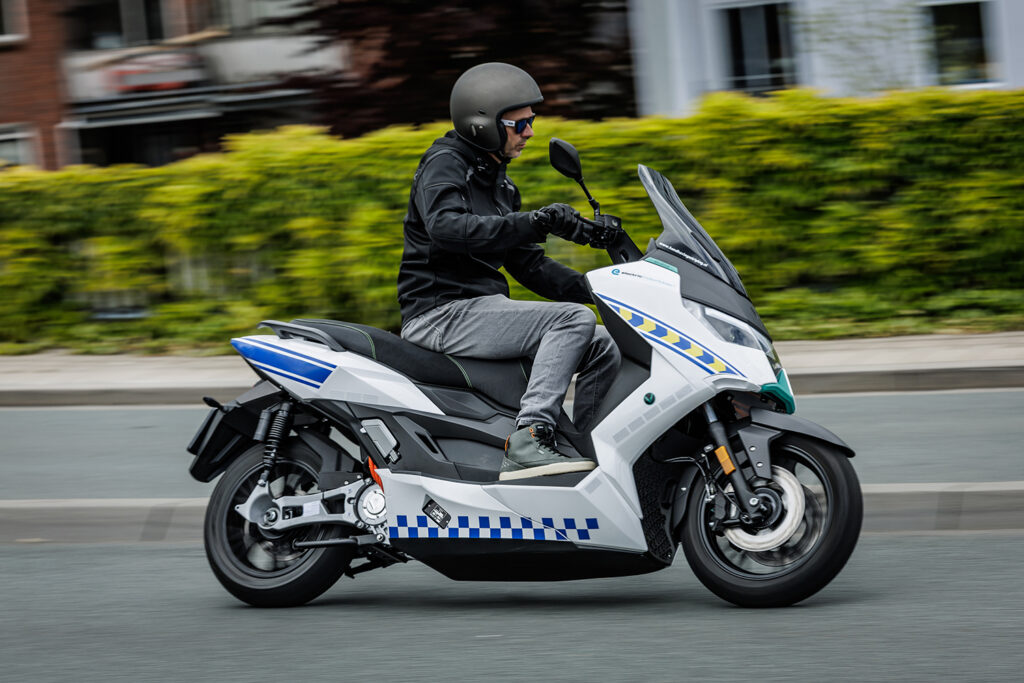
Nerva was founded in 2019 and currently offers four models. The EXE II sits in the A1 class at 11 kW continuous power, which opens it up to a wide audience. The design makes a bold statement: a wide front nose houses a dual LED headlight unit with daytime running lights, topped by a fixed smoked windscreen. The bodywork is clean and purposeful, with a central tunnel that also integrates the Type 2 charging port.


The seat is wide and features a fixed backrest (not adjustable), and testers found it positioned slightly too far forward. It opens in reverse TMAX fashion, held up by twin dampers, and there is enough space beneath for a jet helmet with room to spare. Footrests are wide, foldable and neatly integrated when not in use. The rear end is equally well resolved, with a wide LED unit and what can genuinely be called high-quality aluminium swingarm and casing work.


The 8.8-inch TFT dashboard delivers a solid information package, including range estimates across all three ride modes: Eco, Normal and Sport. Connectivity runs via the Carbit app with Android and Apple mirroring. The keyless system will feel familiar to Honda riders: a rotary knob combined with a push button for the seat and charging flap.


Battery
Nerva has made a point of specifying BYD LFP (lithium iron phosphate) cells, and it is worth understanding why. LFP chemistry contains no cobalt, nickel or manganese, offers a significantly longer lifecycle: up to 6,000 full charge cycles before dropping below 80% state of health, compared to a maximum of around 2,000 for NMC cells – and carries a five-year warranty. The trade-off is weight: at 230 kg kerb weight, the EXE II is roughly on par with a Honda Africa Twin 1100.

On the road
Nerva specifies a 15-inch front wheel and 14-inch rear, both shod with Michelin City Grip tyres, a choice that deserves credit in a segment where rubber is often an afterthought. Suspension is conventional: telescopic fork up front, twin gas-charged dampers at the rear.


In Normal mode with a full charge, the indicated range is around 140 km, rising to a theoretical 180 km in Eco. Sport mode cuts that to roughly 90 km, though it also unlocks a peak output of 19 kW and a top speed of 130 km/h. The 0–50 km/h sprint takes 4 seconds; 0–80 km/h falls in 7 seconds, respectable figures for an A1-class machine.

The 7.83 kWh LFP pack returned 155 km in real-world testing with a 30/70 motorway-to-city split, at 17°C and a Force 3 wind. Motorway speeds above 93 km/h require Sport mode. Charging from the onboard 3.3 kW charger takes approximately 2.5 hours at home, and the Type 2 socket means public charging infrastructure is also accessible, a meaningful practical advantage. At €0.25/kWh, a full charge works out to roughly €1.75.

The weight is present but not overwhelming in urban riding. Steering requires more input than a lighter machine, and the mass announces itself over speed bumps and raised kerbs. On the motorway the picture reverses: high-speed stability is excellent and crosswind sensitivity – a common weakness on scooters – is notably low. The braking package consists of dual radial front calipers on twin discs and a single rear disc. Stopping power is strong, if slightly lacking in progressive feel. A reverse gear is included, which is genuinely useful for parking. Brake levers offer five-position adjustment, accommodating smaller hands.

The NERVA EXE II is priced at €8,490 including BPM in the Netherlands, and €7,990 in Belgium. At that price point, with this range and performance package, Nerva is making a serious case for itself in a segment where the competition either falls short on range, size or value.
The original Dutch article, made by scooter&bikexpress, can be found at the website of Electric Motorbikes Netherlands: