
Whistleblower questions Donut Lab’s battery promises as Verge Motorcycles deliveries slip


At CES 2026 in January, Donut Lab announced what it called the world’s first solid-state battery ready for production vehicles, claiming the battery would power Verge Motorcycles‘ lineup with first deliveries in Q1 2026. The claims were extraordinary: an energy density of 400 Wh/kg, a full charge in five minutes, endurance through 100,000 charge cycles, and operation in temperatures from −30 to 100°C, all at a price lower than current automotive lithium-ion batteries.
Verge and Donut Lab are deeply intertwined. Donut Lab was founded in August 2024 as a spin-off from Verge Motorcycles, with the same founding circle.
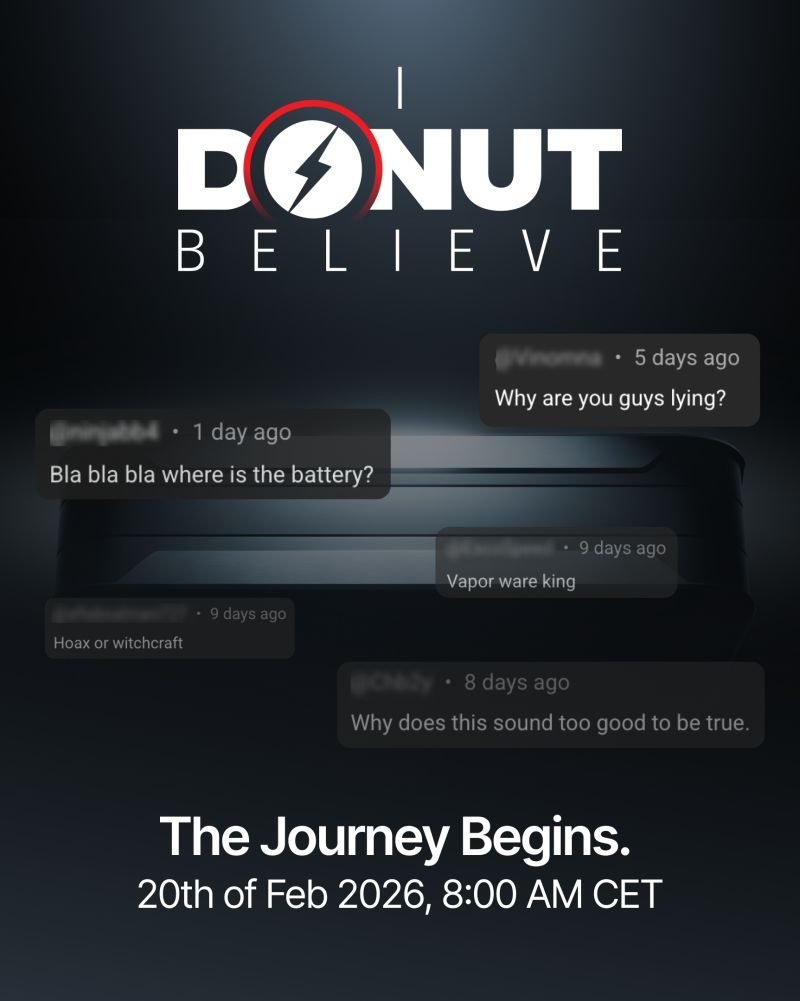
Expert skepticism from day one
The announcement was met with immediate and sharp pushback from the battery industry. CATL’s head of off-China operations, Ulderico Ulissi, said the announced claims were “clearly fake.” SVOLT CEO Yang Hongxin called it a scam, saying a battery with those technical details “does not exist.” Professors and researchers from several universities cast doubt on the specifications and urged the public to wait for evidence.
At the battery’s unveiling, no independent testing was presented to support the claims, and the company presented mockups in place of actual batteries.
The delivery slippage

The Verge TS Pro equipped with the Donut Lab solid-state battery was promised to customers by March 31, 2026. Shortly after, the website’s delivery window for new orders shifted to Q4 2026. Verge CEO Tuomo Lehtimäki tried to soften the impact, telling InsideEVs: “First orders received last year for Verge Motorcycles will start in Q1 as previously mentioned. New U.S. orders received now can expect a bike delivery in Q4.” However, a report in Finnish business press Kauppalehti painted a more sobering picture: Lehtimäki told the outlet that orders extended well into 2027, and that production this year was capped at roughly 350 bikes.
A pack-level test – But key questions unanswered
In March, Donut Lab attempted to address critics with a public charging test. An 18 kWh battery pack charged from 10% to 80% in 12 minutes at over 100 kW inside a Verge TS Pro motorcycle, using only air cooling, the first pack-level test the company had conducted. This was notable, but as Electrek pointed out: the two biggest claims, 400 Wh/kg energy density and 100,000 charge cycles, had still not been tested or demonstrated.

The bombshell: a criminal complaint
The story escalated sharply this week. On April 17, Lauri Peltola, co-founder of Nordic Nano Group, an R&D company working with Donut Lab on the battery, told Finland’s leading newspaper Helsingin Sanomat that the bold claims were “simply not true,” and filed a criminal complaint with government officials.
The allegations are specific and serious. According to Peltola, “the promised battery properties, such as energy density and charging cycles, have not been achieved. The readiness for mass production has also been misrepresented. The company does not have the promised capacity for mass production and large production volumes of batteries.”
Critically, Helsingin Sanomat says it obtained internal communications revealing the full supply chain picture: CT-Coating develops the technology, Nordic Nano handles battery production, and Donut Lab acts as the productizer and commercializer, a relationship Donut Lab had never publicly disclosed. Even more damaging: CT-Coating stopped development of the battery that Donut Lab had been advertising and submitted for testing at Finnish national lab VTT, having moved on to a new generation that is still in early development.
Independent testing of CT-Coating’s batteries found an energy density of 268–297 Wh/kg, far short of the claimed 400 Wh/kg.

And in what may be the most revealing moment yet, Donut Lab CEO Marko Lehtimäki himself confirmed in an interview with Helsingin Sanomat that the 100,000-cycle claim had never actually been tested, it was extrapolated from “lower numbers.”
Helsinki police have confirmed a criminal report was filed against a battery technology company this month. Peltola has also filed reports with Finland’s Financial Supervisory Authority and the Chancellor of Justice’s external reporting channel.
Donut Lab and Nordic Nano’s response
In a joint statement, Donut Lab and Nordic Nano denied “having committed any crime or misleading investors,” and described the complainant as not having “the necessary knowledge of battery technology or the overall picture of the development work.” Nordic Nano CEO Esa Parjanen dismissed the claims entirely, saying Peltola had no involvement with the battery project. Both companies say they stand by their published battery specifications and plan to release further independent test results in the coming months.
Financial red flags
The controversy isn’t limited to battery chemistry. PwC, Verge’s auditor for its Estonian subsidiary’s 2024 financials, reported that it could not complete its audit because the company lacked almost all financial information on inventory management, sales receipts, research expenditure, and property values. The Estonian subsidiary has no cash and depends on loans from its Finnish parent company, its management, and their relatives.
Helsingin Sanomat also reported that Donut Lab had contacted individual Finnish investors and promised returns of hundreds of percent within a few months. The Finnish Broadcasting Company published an investor pamphlet by Donut Lab touting tenfold returns within 18 months.
Sources:
Autopian
Donut Lab
Wikipedia
RideApart
RideApart
EVShift
Electrek
Science
Helsingin Sanomat
InsideEVs